


There are stories that do not limit themselves to explaining a story, but rather force us to take a position. Persepolis is one of them.
On 19 March, within the framework of the event organised by the Alcorcón City Council on the occasion of 8 March, María José R. Becedas, President of the Association, participated in an event where the film Persepolis was screened and moderated a subsequent round table in which Kadhija Amin and Nilufar Saberi explained how rights — especially those of women — can advance or go backwards depending on the social and political context.
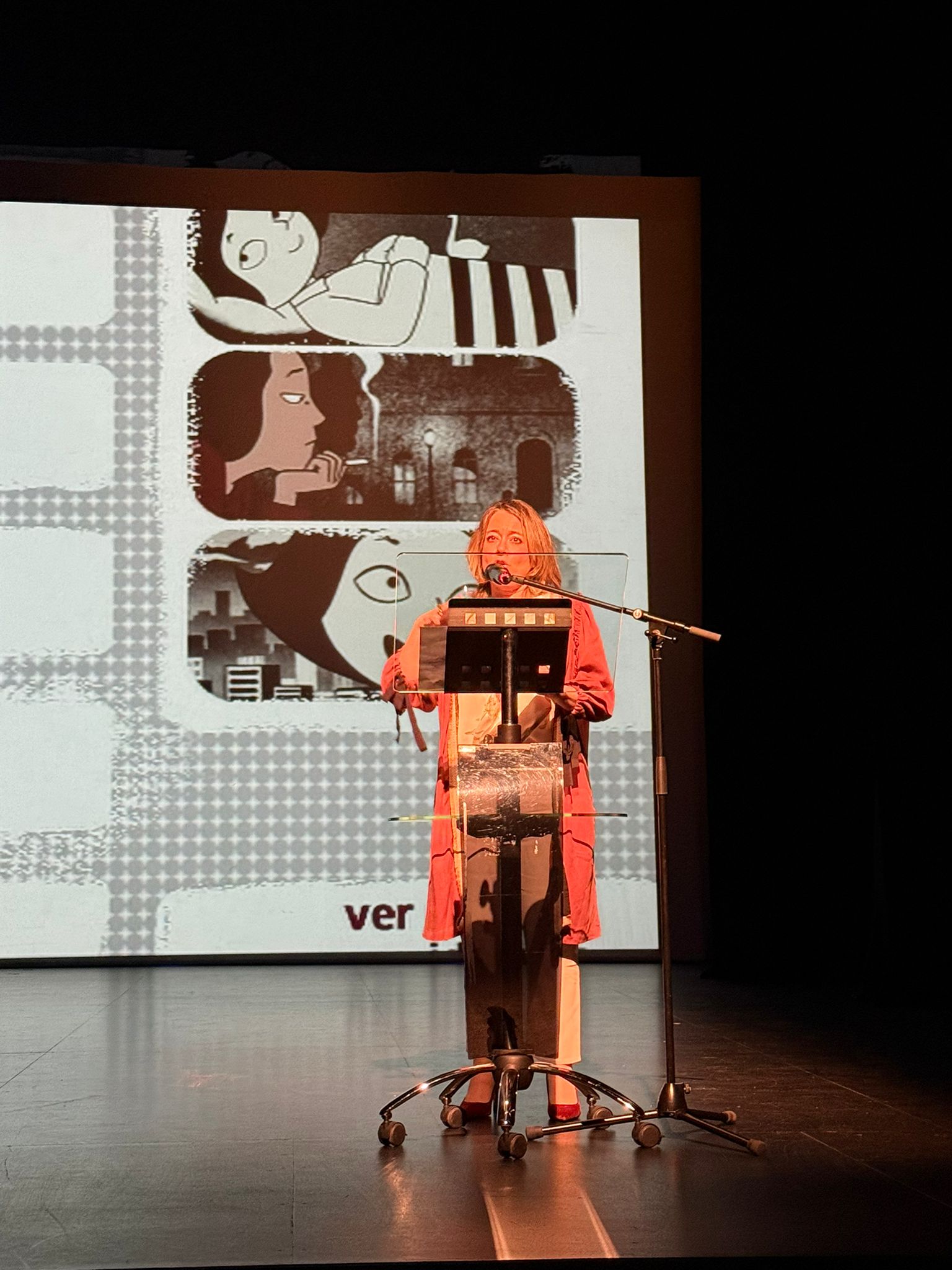
Persepolis Persepolis talks about Iran, but also about identity, freedom, imposition, resistance from the most intimate aspects of a woman’s life. To do this, it tells the moving story of an Iranian girl from the Islamic Revolution to the present day. When the fundamentalists take power, forcing women to wear a veil and imprisoning thousands of people, and while the war between Iraq and Iran takes place, Marjane discovers punk, ABBA and Iron Maiden. When she reaches adolescence, her parents send her to Europe, where she encounters another culture that has nothing to do with that of her country. The protagonist adapts well to her new life, but cannot bear the loneliness and returns to her family, even if that means putting on the veil and submitting to a tyrannical society.
The screening of the film was the starting point for an uncomfortable and necessary conversation about the fragility of women’s rights and collective responsibility in the face of their regression. The subsequent debate brought together two voices whose life experiences have been shaped by the same reality that the film portrays: Nilufar Saberi, an Iranian human rights activist, and Khadija Amin, an Afghan journalist and defender of women’s rights. Two different experiences, but connected by a common thread: the direct impact of regimes that have turned control over women into a political instrument.
From the beginning, the conversation was placed on a clear level that shows that Persepolis is not just the past. It is the present. And not so distant.
Nilufar Saberi expressed it forcefully by connecting Marjane’s story with her own experience: rights can disappear in a very short time. What at one moment forms part of everyday life — education, freedom of movement, the ability to decide — can become an object of restriction or even a crime when the political context changes. Her journey, from her departure from Iran after the establishment of the Islamist theocracy to her current activism, is an example of that abrupt break between a possible life and an imposed one.
In parallel, Khadija Amin brought the Afghan perspective, where the regression has not only been rapid, but systematic. The exclusion of women from education and work is not a collateral effect, but a deliberate strategy of control. Her experience as a journalist in Afghanistan — and her subsequent departure following the arrival of the Taliban — shows how the loss of economic and educational autonomy makes women particularly vulnerable.
One of the main themes of the dialogue was the relationship between education and work. Without access to both, and without economic independence, rights and the ability to resist disappear.
The conversation moved towards a particularly uncomfortable question: the risk of normalisation. In Afghanistan, the measures adopted by the Taliban regime have been described by various organisations as gender apartheid, a legal and social structure aimed at eliminating women from public space. But the question raised was broader: can this vision spread or be tolerated by the international community?
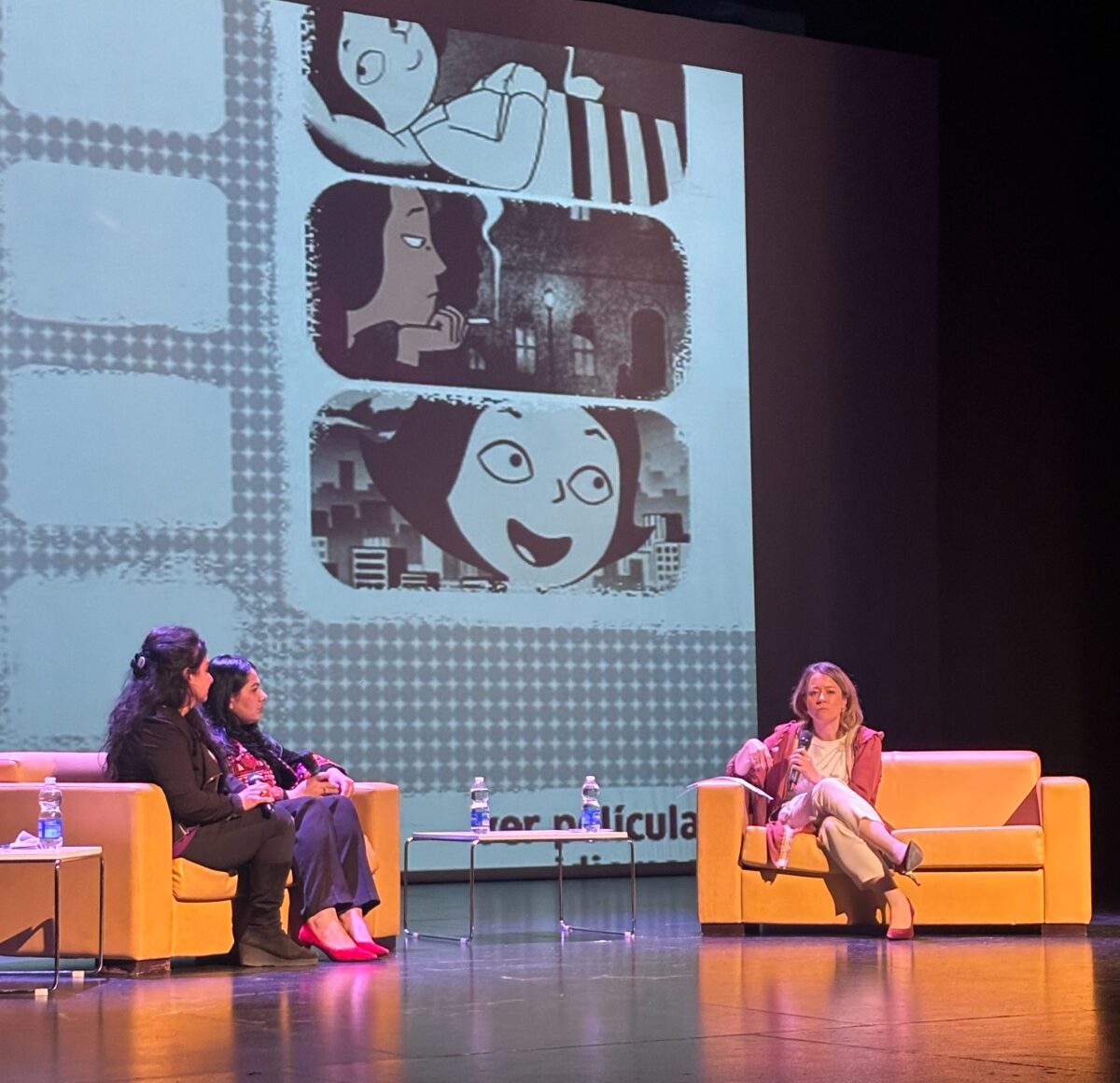
The answer, although nuanced, pointed to a real risk: normalisation does not always come in the form of explicit acceptance, but through inaction, relativisation or disconnection. When these regressions are perceived as “other people’s problems”, the capacity for a global response is weakened. And what do we do? Do we watch or do we act? Responsibility is not limited to governments. It also concerns organisations, companies and social leaders.
The analysis also addressed the repression of dramatic current relevance suffered by Iranian society and the need, as Nilufar Saberi pointed out, for external intervention to recover freedoms and fundamental rights. It also dealt with a particularly complex issue: the veil. In Persepolis, it appears as a symbol of political imposition on the female body. And Nilufar says it very clearly: it is a sexist form of domination over women. However, the current debate in Europe introduces another dimension: to what extent can the imposition and also the prohibition of certain garments become a form of control?
At a time when the debate on equality may seem consolidated in some environments, it was recalled that no progress is guaranteed. And that, as Persepolis shows, history can change faster than we think.
Writer: María José R. Becedas